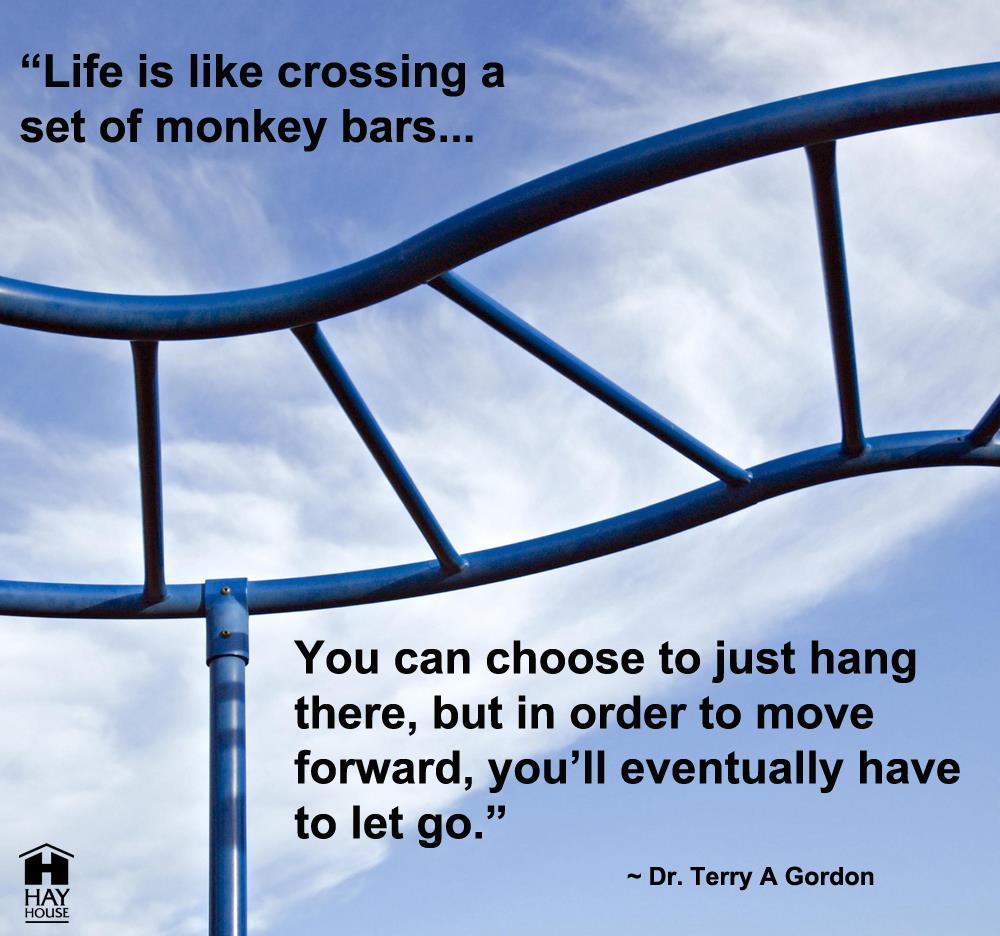
Letting go

Letting Go

The hardest thing I may never truly master in my life is the art of letting go.  I have this idea that letting go is simple yet when the moment comes, I can be at a total loss. If I wrote out all of the things in my life I have chosen to let go of it would be an incredibly brief list.

I have to laugh at myself because it is kind of ridiculous.  Letting go of things that do not serve purpose in my life should be easy so why is it so damn hard?  I hang on to things that are not helpful, not inspiring, not even rationale at times.  I wonder how long I can hold on to these familiar emotions and continue to let them saturate my heart with sadness and frustration.  I witness other people’s struggles and can easily identify the things they could let go…and often think “why do they continue to have the same struggle within themselves, can’t they see it gets them nowhere?”  Yet, I often fail to remember or maybe even comprehend the same magnitude of power for my own struggles.

I know that I only need to let go of things that have no value for me.  When I’m sitting in the car stuck in traffic, I can let go of my frustration or I can sit there and hold it in and express it through various explicit salutations and exasperation.  When a family member demonstrates their inability to consider an alternative viewpoint I can choose to let go of my expectation that they will gain a new perspective or stay stuck in that place of irritation and disgust that their values conflict with my own.  Yes, I can choose to let go of these things yet I often choose to stay in that space of anxiety or pain.

The problem with letting go is that if I let something go there is this fear of “what will fill that space?”  I am only now realizing that when I let things go that have no importance in my life, it is quickly filled with something much more powerful and amazing.  It is replaced with hope.  Because then I am hopeful that the space that was holding on to all of that useless emotion and energy will be replaced with inspiration and love and even acceptance.  And let’s face it, those things simply feel better than anger, frustration, worry, and stress.   Through letting go, I can release this need to control things/events and how people respond to me.  Don’t get me wrong, I like control.  Control makes me feel safe.  Control makes me feel powerful.  The problem with all that control is that it takes up way too much time trying organize things, maintain order, and such.  In turn, when I am holding on to things I am unable to be in the present moment for what it is.  When I let go I am actually being more thoughtful and present in my life than any other time I choose to ‘stay stuck’ in all that negative space. I am able to see the beauty in something or open my heart to an experience that would have otherwise been shut down.

I value being present in my life, I value experiencing hope and love, and I value seeing the good in people.  Next time I find myself wrapped up in an inner struggle that I could choose to let go, I will simply remind myself of what it is I value and let anything that doesn’t match up with those values simply go.  The best thing that I can remember, and anyone for that matter, is that letting go is a practice.  And sometimes our practice will be awesome and sometimes our practice will have lots of room for improvement.  I do believe that as long as we are willing to engage in a practice, we will grow no matter how difficult it may feel or awkward it may be.  As long as I’m growing, regardless of the pace, all will be okay.  In retrospect, maybe this isn’t something that I need to master after all; I simply need to practice and keep practicing until the art of letting go no longer feels like a struggle and instead feels like an amazing opportunity for peace within myself.
A little dose of self-compassion

An entire wall of mirrors, another wall of windows, and a class full of thin, trim, and apparently very flexible 20 somethings has led to a much-needed practice of self-compassion this evening.  As I stared at myself while navigating this part Pilates and part Yoga (PiYo) class, I almost laughed at how ridiculous I looked.  Of course, I quickly wavered between laughter and outright frustration as I tried to figure out how to go from a ‘low lunge’ to a ‘downward dog’ without falling over.  Oh yes, the entire hour was full of self-talk ranging from “what the hell is she doing?” to “oh no, I think I just pulled a muscle” and “holy cow, is that a trick mirror?”  Those thoughts were tough enough, but then it only got worse when I started comparing my moves to the women around me or, gulp, the pencil thin instructor.

It was apparent that my inner critic was way too loud tonight.  All of those negative thoughts and ideas kept me from focusing on the fact that I finished the class without falling and that I got a great workout.  Not to mention that I totally tried something brand new today.  On days like this when I get caught up in what my body looks like, how people may or may not perceive me, and compare my own success to what others are doing around me, I have to be very deliberate and practice self-compassion.

The first step is acknowledging that I’m being incredibly critical of myself.  Next thing is to take a moment and identify the good things about the experience.  Third step is to remember why I took the class to start with, and then re-frame everything in my head like I was talking to a close friend (because I would never be so harsh to a friend).  The final step is to take all that revised information and let it sit in my heart for a few minutes while taking in some deep breaths.

Self-compassion is not always easy, but I do believe it is always necessary.  I think the more we practice compassion for ourselves the easier it becomes to feel compassion for others.  And then, the more we experience compassion for others, the easier it becomes to experience for our own self.  And when we are more compassionate, the more likely we are to engage in meaningful and productive experiences instead of isolating ourselves and feeling disconnected.  So whenever I catch my inner critic chatting away too loudly, I will simply remind myself to take a deep breath, practice some self-compassion, and enjoy the experience for what it’s worth instead of withdrawing and robbing myself of a potentially awesome interaction.  So bring on the PiYo classes and bring on the new and exciting adventures.  With a little dose of self-compassion, I believe we can do anything we set our hearts to.


The power of hope is stronger than the turmoil of worry

When is the last time someone asked you, “What are you hoping for?”  And how often do we spend time thinking about our hopes and dreams?  I say things all the time like, “I’m hoping for a quiet day today” or “I hope traffic isn’t backed up this morning.”  But I don’t really think about what it means to be hopeful when I’m saying these things.  I have things in my life I think about often, including work, financial security, my parent’s health, the people in my life, emotional stress, the tragedies that occur each day, and my overall state of well-being, but what I get from all that is a lot of time worrying and not so much time hoping

And let’s be real, who can blame me?  The media and our culture tell me every day a host of things to worry about including health, politics, the BPA in plastic, global warming, gas prices, community violence, and the unstable economy just to name a few.  I stopped watching the news on a regular basis because I just couldn’t stand it any longer.  Each broadcast seems to start with a highlight of something violent, traumatic, and/or otherwise tragic.  I don’t know if I have ever seen a news hour with a promo of  “This is going to make your heart sing…so stand by and get your daily dose of uplifting news.” Or better yet, how about “Look, we are about to give you some really overwhelming and scary information but we promise to end out the news cast with solid strategies to reduce your anxiety and improve your sense of calm and peace.

I can’t help but wonder what we are doing to our younger generation when we subject them to all of this worry instead of instilling more hope.  If I ask a teenager what they hope for.  They may start off by saying something like “I hope I’m rich and famous someday.” But when I go ahead and ask them a couple of more questions, like “So if you’re rich and famous, what will that mean for you?”  or “What if you were rich and famous right now, what would be different?”  It takes a few rounds of creative questioning, but eventually I hear “…because if I have money and fame then I won’t have to worry.”

The reality is that we have been conditioned to be more comfortable in a state of fear, worry, and angst than we are in a state of peace or hopefulness.  Not to mention that we are constantly being told that we need more money and everything is getting more scarce and the concept of ‘enough’ is almost unheard of.  It’s so sad that we are programmed to respond to the routine question “How are you?” with a dismissive, “Oh, I’m fine.  Thanks.”  Because then we end up in this place where we don’t really share our insecurities or worries nor do we create a space to resolve them with acts of hope.  This is a common place I like to call turmoil.  Unfortunately, I know this space too well.

So how do we get out of the turmoil and make a left turn towards hope?  I believe we have to start by acknowledging what it is that is really worrying us so much and then invest time and effort in figuring out how we are doing address it.  And a major part of this process is: 1) being honest about what it is that we are wanting, and 2) defining what reasonable steps we are willing to take in that direction. The raw definition of hope (according to Dictionary.com) is the feeling that what is wanted can be had or that events will turn out for the best.  And an effective way of feeling that something CAN happen is to identify at least one strategy that puts us one step closer to our stated desire.  So figure out what you need and then create movement in that direction.

Essentially, when we make goals…we promote hope.  And I believe it’s not just hope for ourselves, but for other people too.  I know that when my friends start showing me their accomplishments or telling me of their goals, I start thinking “Dang, I need to get off my butt and do something useful too.”  Now, it does help to have awesome friends who inspire you to be better and challenge you out of your comfort zone, but even if your friends are not lighting fires beneath you; think about how you can be the source of that fire for someone else as well as for yourself!

Of course, I can’t make goals to control things like illness, tragedy, or even how someone will react to me, but if I create strategies that help me address stress, sadness, and other overwhelming feelings…I can at least have options to explore when these things happen.  I guess what I’m getting at is that I realize I can’t control all of these external things happening, but I always have a choice on how to respond.  I can choose to respond with worry, fear, and anxiety or kick all that to the curb and respond with hope, love, and faith.  Those are the things that promote my feelings of safety and security which increase my state of hopefulness and ultimately, my well-being.  Yes, I admit; it’s much easier to say it than to do it.  But as always, this is my reminder that doing it feels much better than just talking about it.

Peace.

Afternoon by the river

Afternoon by the river

Vocabulary of Love

One of the exercises for my Anthropedia training included developing a list all of feelings that I  link to the expression of love and kindness.  It seemed like such an easy task, and who doesn’t love to make out lists?  Ha!  But when I sat down to write the list, I realized a sudden limitation of my own vocabulary.  What feelings do I think about when I feel love or kindness towards someone?  I mean, it seems so obvious, you love someone so you feel love, right?  I mean, I guess “warm and fuzzy” don’t really qualify as formal definitions.  Needless to say, I had some work to do in this area.

I finally came up with this list, and no…it’s not my exhaustive list.  But it’s a start.  I associate all of these things, in various forms, to the idea of love and kindness:  Gratitude, kindness, compassion, joy, warmth, forgiveness, generosity, understanding, patience, thoughtfulness, happiness, adoration, helpfulness, meaningful, a sense of belonging, frankness, tolerance, comfortable, trusting, acceptance, modesty, and inspiration.

The second part of this exercise was to spontaneously define each of those words and then compare it to the formal definition in a dictionary and decide which definition I wanted to go with.  Then I needed to think of a specific time when I experienced that particular word.  My initial thought was ‘holy cow, that’s going to take some time’.  But I knew that it would be worth it to complete this exercise and see how evident love and kindness are in my life.  So I did it, and going through each word, figuring out what I thought it meant and comparing to a formal definition really helped me understand how I use the words in my daily life. The best part was writing one sentence about a time I experienced each of the words in an interaction with someone.  Boy, talk about a fun task….yes, it took me a little longer than I would like to admit when it came to some of the words, such as ‘tolerance’!  I tend to be pretty passionate about my views so it was a good practice to think about the last time I truly experienced tolerance with someone.  It also made me super aware of how many opportunities I miss to experience more love and kindness through some of these actions.

Overall, I realized that I can easily identify moments when I feel love or kindness from a family member or close friend but I often overlook those times when every day people opt to show kindness or spread love and I am the lucky recipient. Whether it’s experiencing gratitude from the lady at the DMV who helped me clear up a mistake on a traffic ticket, or understanding from a coworker who simply lets me vent about a crappy day, or the unknown driver who patiently let me merge on the highway instead of speeding to pass me up (and therefore is practicing tolerance)!   All of the opportunities are times when I can choose to experience love and kindness exactly as they are and store the goodness to help me through those days when it may not be so abundant. My hope is that after reviewing my sharpened vocabulary related to expression of love and kindness; it makes me more aware of how I can promote it within my own interactions each day as well.